Genspark’s GenOffice Alpha, announced on August 3, 2026, put an AI agent inside a downloadable office application rather than leaving it beside a document in a chat window. The product combined documents, spreadsheets, slides, and PDFs with conventional editing tools. Its open-source release creates a concrete example of the browser-and-office agent’s changing destination: a file that people can continue working on after the conversation ends. Genspark releases GenOffice Alpha.
A browser agent can click the right-looking controls and still leave a job unfinished. A save may fail, a page may be stale, or a search result may refer to the wrong record. For enterprise autonomy, the important artifact is a receipt showing what the application actually accepted, not a transcript of attempted actions.
WebArena, submitted July 25, 2023, created realistic, reproducible website environments and tasks judged by functional correctness. Its design moved evaluation toward the state of working applications. The published baseline results belong to that study and are not evidence of current production performance. WebArena paper.
Confirm the state transition
For a hypothetical inventory update, the receipt might identify the item, the field changed, the new value, and the application's confirmation. Our recommendation is to verify these after the action rather than infer success from a button press. The same idea applies to a submitted form, created appointment, or downloaded report.
GAIA, introduced November 21, 2023, combined reasoning, browsing, multimodal handling, and tool use in assistant tasks. It illustrates how a seemingly simple request can require several capabilities in sequence. Each additional transition is a reason to preserve evidence about where the agent obtained its answer. GAIA paper.
Design for interrupted work
A receipt also helps a workflow resume after an interruption. The next run can determine whether the previous action succeeded before repeating it. We would make that recovery path part of acceptance testing. Reliable browser autonomy is less about uninterrupted activity than about maintaining an accurate account of what has happened, what remains to be done, and what should never be duplicated.
From a web result to a working artifact
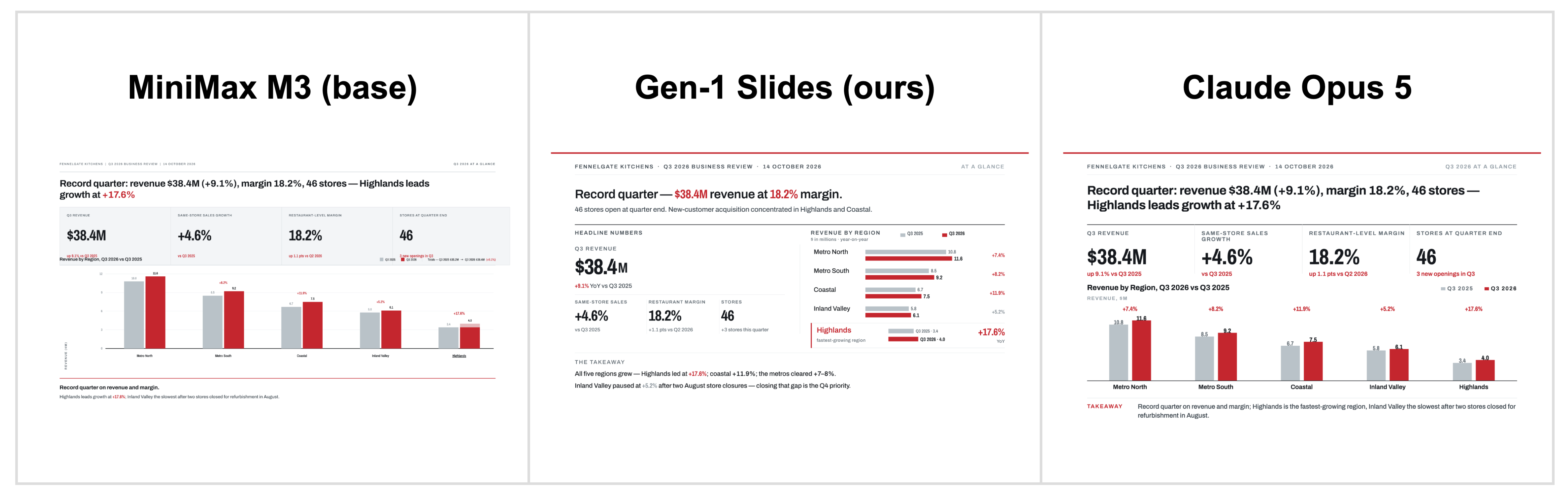
Genspark’s September 10 Gen-1 Slides announcement disclosed a specialist model with a render-and-revise loop and reported lower per-deck costs than its chosen Claude comparison in an internal test. The price result belongs to that setup. More revealing is the method: inspect the created artifact rather than assume generation finished the job. Genspark introduces Gen-1 Slides.
Why browser success is not enough
The older WebArena and GAIA research frames the problem from a different angle. The former placed agents in functional websites; the latter combined questions with the tools and information needed to answer them. Together they separate navigation from reasoning. An office agent adds another separation: finding a source is not the same as correctly incorporating it into a file. A browser action can succeed while the interpretation of its result remains wrong.
For example, a corporate profile may identify revenue for a financial year, while a presentation asks for a calendar-year comparison. The page loaded successfully, the number was copied accurately, and the slide rendered without overflow. The conclusion can still be misleading. This is not an argument against automation; it identifies why an artifact-producing agent needs a longer chain of evidence than a screen-operating demonstration reveals.
The editing surface becomes a control surface
An editable document is useful because a human can inspect and change individual claims without regenerating everything. That property also changes how the agent can recover. A failed chart need not invalidate the entire report if the application preserves the source data and the surrounding argument. A mistaken date can be repaired locally if references remain attached to the relevant passage. By contrast, an attractive but flattened output can be difficult to audit and expensive to maintain.
The architectural question is whether the agent treats the file as structured work or as a finished picture. The former supports revisions, comparisons, and attribution. The latter optimizes for first impressions. Both may be marketed as autonomous creation, but they produce different handoffs for the next person. The distinction becomes especially visible when a user changes one assumption and expects every dependent table, chart, and sentence to follow.
The competitive test comes after generation
GenOffice’s Alpha release and the subsequent specialist model show two parts of Genspark’s strategy: own the editing environment and train for a particular kind of output. This does not by itself establish an advantage over an established suite or a general-purpose agent using the same files. It does give the company more control over how an action changes the artifact and how that change is checked.
The most informative comparison would start with the same source pack and finish with another person revising the result. It would expose errors that a first-view preference test misses: broken formulas, missing provenance, chart labels that do not update, or layout changes that hide caveats. Such a comparison would test the product’s promise of completed work rather than only its ability to produce it quickly.
The broader autonomy story is consequently less about eliminating the user interface than making the interface a place where an agent can leave legible work. A file that remains understandable and editable lets automation extend human effort across time. A file that only looks finished transfers the remaining difficulty to the next reader. Genspark’s releases make that distinction a current product question, not just a benchmark concern.
The research behind the release
GAIA, introduced in November 2023, combined reasoning, multimodal understanding, browsing, and tool use in questions designed to be straightforward for people. The benchmark did not equate every successful click with a correct answer. That distinction carries into document production. A file can contain a correct answer in an unusable form, or a usable form around the wrong answer. Evaluating both layers requires following the material from source to output. The office agent’s advantage would be strongest where it makes that chain shorter and easier to inspect, rather than where it merely conceals the chain behind a polished interface. Original research paper.
Sources & evidence
This archive preserves its original editorial date. Sources describe the events and announcements discussed; they do not establish today’s status.